
Home › Blog › Farm and countryside days
Best rice farming experience in Da Nang: step into harvest season
By the Cáo Experiences team · 2026-11-06
We run rice farming days on family-owned paddies in the countryside outside Da Nang, a 30–40 minute drive from the city centre. You arrive mid-morning, change into work clothes we provide, and spend 3–4 hours learning to plant seedlings or harvest rice by hand alongside the farmer and our host. You'll wade into mud, tie rice stalks, understand why water levels matter, then return to the farmhouse kitchen where we cook lunch together using vegetables and herbs grown on the same land—often with rice, fresh greens and fish sauce made by the family. It suits families with kids aged 8+, couples, solo travelers and groups. Beginners worry about getting stuck in mud (you won't—we show you how to move); seniors ask if standing is tiring (you can kneel or sit on a stool). We adapt for rain, allergies and mobility limits. Ask us for dates and a quote on WhatsApp. Ask about dates on WhatsApp
Why is a Da Nang rice farm better than a market tour?
The Quang Ba flower market and Ben Thanh market show you what farmers sell; a rice paddy shows you how they grow it. On the farm, you do the work—not watch it. You learn why flooding matters, how to read soil, when to harvest by feel not sight. A street food and market tour teaches you ingredients; a farm day teaches you respect for them. You taste rice at every stage: green shoots, mature grain, cooked. The difference is doing, not observing.
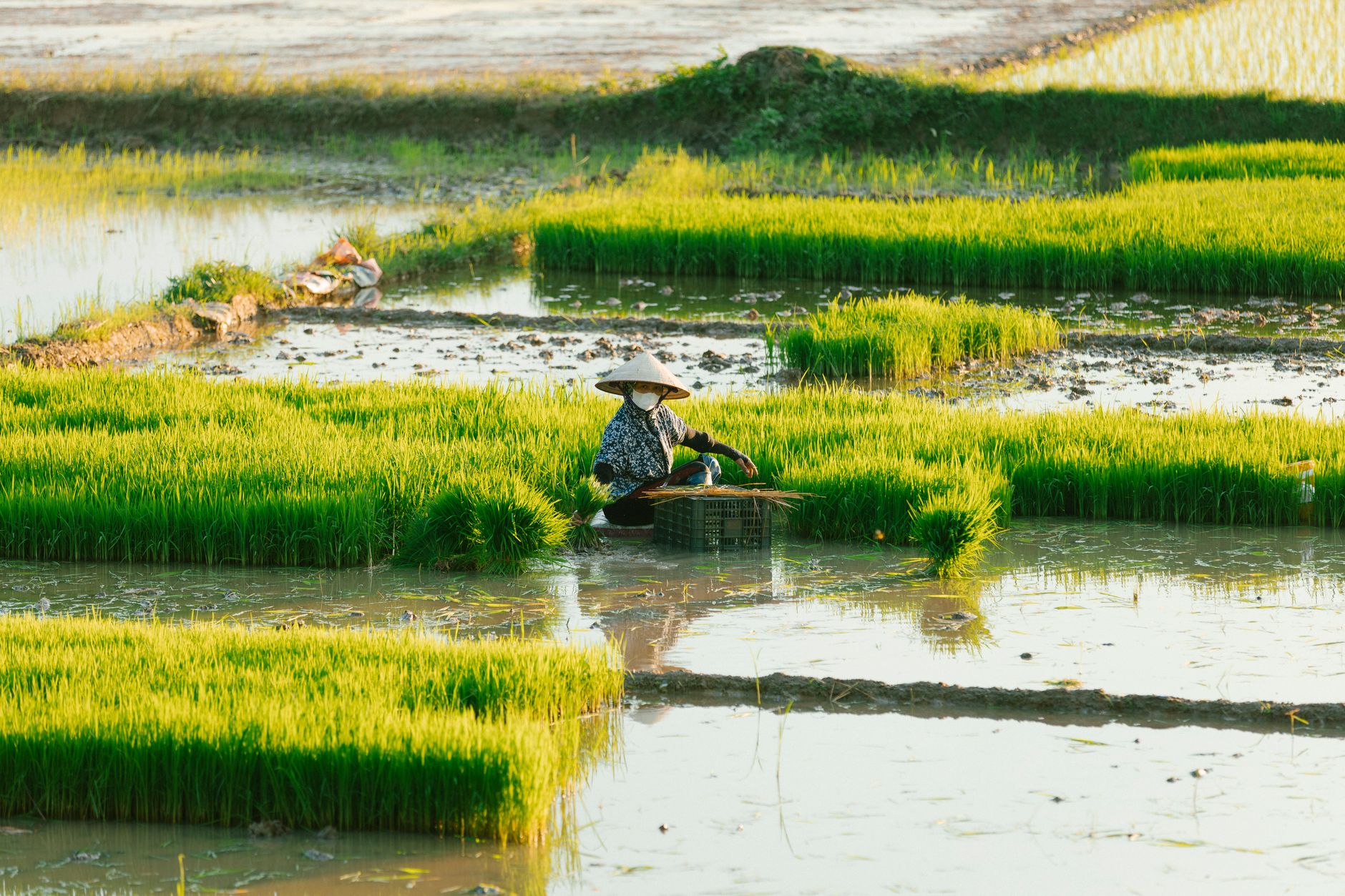
What do you actually do for 3–4 hours?
Hour 1: arrival and prep. You arrive at the farmhouse. We show you how to wrap your ankles, step into mud, and move without slipping. The farmer demonstrates planting or harvesting—whichever is happening that week. You ask questions. Kids love watching the farmer's hands; they're fast and sure.
Hour 2–3: work in the paddies. You do it yourself. Planting means pressing seedlings into mud in rows—your knees and palms get wet. Harvesting means wading to bundles of ripe rice, cutting them with a small sickle, stacking them to dry. Your back feels it. That's the point: you understand why farmers' bodies ache, why water buffalo are cherished, why a good season matters to a family's year.
Hour 4: farmhouse kitchen. You rinse off at a hand pump (cold water, exhilarating). Then you cook. The farmer's wife or daughter teaches you to cook rice on a wood stove, stir-fry greens with garlic, fillet fish if you're doing a full day. You sit on low stools, eat slowly, ask about their life—kids, school, dreams. This is where most guests cry or go quiet. It's not tourism theater; it's a real lunch in a real house.
Who should book a rice farm day, and who shouldn't?
Best for: Families (kids 8+); couples wanting a shared challenge; solo travelers seeking a day off the tourist trail; groups wanting to do something together, not just see it.
Not ideal for: People with severe mobility issues (mud is unpredictable); travelers on a 1-day Da Nang stop (jet lag will crush you); anyone expecting luxury (you'll be dirty, tired, happy).
Families with young kids (5–7): We've run sessions with 5-year-olds. They don't harvest much, but they play in mud, learn where food comes from, eat with farmers' children. It's 2–3 hours of work + 1 hour lunch, not the full 4. Ask us about a kids-focused version.
Seniors (60+): Absolutely. A 70-year-old from Hamburg harvested rice last month, kneeling some of the time, sitting on a stool the rest. The farmer's pace is slow and steady. Bring water, sun hat, and tell us about your knees beforehand.
Groups (6–12 people): We usually split you into two paddies with two hosts. You'll still feel like you're working, not queuing.
How do we adapt for rain, allergies and dietary needs?
Rain: We reschedule or offer a covered-shed version where you learn rice processing (threshing, winnowing) instead. It's less muddy, more technical, and honest—farms don't stop in drizzle.
Allergies: Tell us before you book. We know which farms grow what. We avoid peanut fields if that's an issue. Lunch can be dairy-free, vegetarian, shellfish-free—the farmer's kitchen is flexible.
Mobility limits: Kneeling hard? We provide a plastic stool. Standing long? You can shift between rows or sit on the paddy edge. No one is forced to do anything. We've had guests with arthritic knees who spent 2 hours learning from the farmer while sitting, then helped cook. That counts.
Kids getting bored: Under age 6, they get 1.5–2 hours max. Over 8, they work hard and are proud. We bring a ball, snacks, let them play with the farmer's dog between sessions.
What to check before you book a rice farm day
| Question | What to ask us | Why it matters |
|---|---|---|
| What season are we visiting? | "When does this farm plant vs. harvest?" | You can't plant in harvest season. We pick farms with activity matching your dates. |
| How muddy will I get? | "Full submersion or ankle-deep?" | Affects clothing, confidence, how strong your core needs to be. |
| Can I bring a child under 8? | "What's the minimum age and can they do less work?" | Some farms have rough boundaries (irrigation ditches); under-5s shouldn't go unsupervised. |
| Is lunch included? | "What's cooked, and can you adapt it?" | Full-day experiences include a cooked meal; half-day often doesn't. Allergies matter. |
| How far is it from Da Nang city? | "Exact travel time?" | 30–50 minutes depending on traffic and farm location. Plan your afternoon. |
| Do you provide work clothes? | "Shoes, apron, headwrap?" | We provide mud-safe trousers and apron. Bring old shoes you don't mind ruining, or we loan rubber boots. |
| What's the group size? | "How many people, and will there be strangers?" | Smaller (4–6) feels more intimate. Larger (8+) has more energy but less 1-on-1 farmer time. |
Is a rice farm day better than a countryside cooking class?
Both teach you where food comes from, but differently. A Vietnamese cooking class in a city kitchen lets you learn technique on clean ingredients. A farm day gets you dirty and grows respect before you cook. Many guests do both: farm day Saturday, cooking class Tuesday, dinner party Friday. A farm experience is the story; cooking class is the skill. Neither replaces the other.
If you want immersion and story, farm first. If you want to take skills home, cooking class. If you can do one, pick the farm—it changes how you eat for months afterward.
How is this different from other Da Nang countryside experiences?
We run horse riding experiences and tea experiences in the Da Nang region too. Here's the honest difference:
- Horse riding: You ride through pine forests or paddy edges. It's about the animal and landscape, not production.
- Tea: You learn the history and flavor of tea. It's cerebral and sensory.
- Rice farming: You do the work. It's physically demanding and emotionally intimate.
Flower arranging and craft workshops teach you to make something beautiful. A farm teaches you to respect something essential. All are real; pick by what you need right now.

What to bring and wear
Bring: Sunscreen (high SPF), a wide hat, water bottle (1.5 liters), phone in a waterproof bag, small towel or sarong.
Wear: Old clothes you don't mind losing to mud stains. Long trousers (optional, but fewer insects). Shoes you can afford to ruin or don't mind going barefoot (we advise against it—leeches are rare but possible after heavy rain). A swimsuit under your clothes if you want to jump in the canal on a hot day (many do).
We provide: Mud-safe work trousers, apron, headwrap or hat, rubber boots if needed, soap and cold-water rinse at the farmhouse.
How do you structure a group session versus a private one?
Private (2–4 people): You arrive, work at the farmer's pace, eat when they eat, ask deeper questions. Quieter. Fewer laughs, more reflection. Usually a couple or a family.
Small group (5–8 people): Two hosts, two paddy sections. You feel the group's energy—someone brave goes deep into mud, others follow. Lunch gets louder. Friendships sometimes start.
Larger group (8–12 people): We book two farms or split the day. Less one-on-one farmer time, but you feel like you're part of a real harvest crew. A school group once sang in the rice field at sunset.
Private is deeper. Group is fun. Both work.
Common worries, honestly addressed
"I'm not fit enough." The work is repetitive, not intense. A 75-year-old can do this. You're not racing. You kneel, plant, shift position, kneel again. Bring water, take breaks—the farmer does.
"Will I sink or get a leech?" Farmers walk these paddies barefoot. You have boots. Mud is 15–30cm deep, firm underneath. Leeches exist but are rare and painless (they numb the bite). One guest got one, we removed it in 10 seconds with salt. She went back and finished harvesting.
"What if I hate it halfway through?" We've never had that. What happens: first hour, you're self-conscious. Second hour, you're focused. Third hour, you're quiet and happy. Come with an open mind, not a plan to endure.
"Can I just watch instead?" You can, but it defeats the point. A farm day is about doing. Watching is tourism; doing is learning.
Why book with Cáo Experiences for a rice farm day
We're hosts, not tour operators. We work with the same three farms year-round. The farmers know us, trust us with groups, teach our hosts how they farm. We don't rotate vendors or overbill. We adapt the session to the actual farm work happening that week, not a fixed script. If it's raining, we reschedule or pivot to processing. If your kid gets scared, we slow down. If your group is fit and curious, we let you harvest for 4 hours straight.
You book via WhatsApp. You get the actual host's number, not a call center. Coordination is human.
Ask us for dates and a quote. We'll tell you which farm is active that week and why it's a good fit for your group.
See how a session runs
Other experiences that pair well with a rice farm day
If you're spending a week in Da Nang, layer your experiences:
- Farm day + cooking class: Learn where food comes from, then cook it. A 3-day arc: farm Saturday, rest Sunday, cook Tuesday.
- Farm + street food tour: Work in fields, eat street food in the city. Context and flavor.
- Farm + tea experience: Hands-on agriculture + refined tradition. Both slow you down.
- Family with kids: Farm day + cooking for families. Kids work, then cook what they grew.
- Group or team: Farm + horse riding or coffee workshop. A full countryside day.
Final decision: is this right for you?
Book a rice farm day if:
- You want a day that stays with you for months.
- You're okay being muddy and tired.
- You want to meet a real farmer and eat in their home.
- You have 3–4 hours and a ride to the countryside.
Skip if:
- You want luxury, air conditioning, or Instagram aesthetics.
- You can't handle mud, insects, or uncertainty.
- You're in Da Nang for 12 hours and jet-lagged.
If you're unsure, ask us. We'll be honest about whether the timing and your mobility suit this experience.
FAQ
What if it rains heavily the day of my booking?
We reschedule to the next clear day or pivot to a covered rice-processing session where you learn to thresh and winnow. We don't cancel without trying alternatives first.
Can I do a rice farm day and a cooking class on the same day?
Not recommended. You'll be exhausted and muddy after the farm. Most guests do farm one day, rest, then cook. But if you insist, farm morning (3 hours), rinse and rest 2 hours, cooking class afternoon (2 hours) is possible. Tell us in advance.
What's included in the price—lunch, transport, equipment?
Ask us for dates and a quote. We'll break down what's included: transport, work clothes, farmer's time, lunch, and our host. Pricing varies by group size and farm location.
Is this suitable for children under 8?
Under 6, we recommend a 2–3 hour adapted session focused on play and learning, not heavy work. Ages 6–8, they can plant or harvest gently for 2–3 hours. Over 8, they work the full 3–4 hours and feel proud. Tell us your child's age and we'll design it.
What happens if I have a food allergy or am vegetarian?
Tell us before booking. We'll confirm the farm's crops and cooking. Vegetarian meals are easy—rice, stir-fried greens, tofu. Shellfish allergies—we check the fish sauce and adjust. Peanut allergies—we avoid certain farms. No surprises.
Can I visit a rice farm on my own without booking through Cáo?
Yes, but farmers rarely receive walk-ins. You'll struggle with language, farm safety, and welcome. Booking through us means the farmer expects you, we translate, and you're insured. It's worth it.
Ask about dates
Tell us the city, your dates and what you would like to try. We reply on WhatsApp in English with options and availability.
FAQ
What if it rains heavily the day of my booking?
We reschedule to the next clear day or pivot to a covered rice-processing session where you learn to thresh and winnow. We don't cancel without trying alternatives first.
Can I do a rice farm day and a cooking class on the same day?
Not recommended. You'll be exhausted and muddy after the farm. Most guests do farm one day, rest, then cook. But if you insist, farm morning (3 hours), rinse and rest 2 hours, cooking class afternoon (2 hours) is possible. Tell us in advance.
What's included in the price—lunch, transport, equipment?
Ask us for dates and a quote. We'll break down what's included: transport, work clothes, farmer's time, lunch, and our host. Pricing varies by group size and farm location.
Is this suitable for children under 8?
Under 6, we recommend a 2–3 hour adapted session focused on play and learning, not heavy work. Ages 6–8, they can plant or harvest gently for 2–3 hours. Over 8, they work the full 3–4 hours and feel proud. Tell us your child's age and we'll design it.
What happens if I have a food allergy or am vegetarian?
Tell us before booking. We'll confirm the farm's crops and cooking. Vegetarian meals are easy—rice, stir-fried greens, tofu. Shellfish allergies—we check the fish sauce and adjust. Peanut allergies—we avoid certain farms. No surprises.
Can I visit a rice farm on my own without booking through Cáo?
Yes, but farmers rarely receive walk-ins. You'll struggle with language, farm safety, and welcome. Booking through us means the farmer expects you, we translate, and you're insured. It's worth it.
More like this
Farm and countryside days
Fishing Experience Vietnam for Japanese Travelers: Where to Go & What to Expect
Vietnam's waterways offer Japanese travelers a chance to learn traditional fishing methods directly from locals. Cáo Experiences runs half- and full-day sessions on rivers, lakes and the Mekong Delta where you cast nets, set traps, and cook your catch.
Farm and countryside days
Fishing Experience Vietnam for Foreigners: Hands-On Guide
Fishing in Vietnam isn't a spectator sport—you'll wade into rivers, cast nets, trap fish in baskets, and cook your catch for lunch. We run small-group and private fishing days in the countryside outside Hanoi, Ha Noi region, and the Mekong Delta.
Farm and countryside days
Fishing Experience in Vietnam: 8 Questions to Ask Before You Go
Fishing in Vietnam means wading through rice paddies, learning trap techniques, or casting in rivers with local guides. Here's what to ask before you book.