 Cáo Experiences
Home › Blog › Flower arranging workshops
Floristry Class in Vietnam: What to Expect
By the Cáo Experiences team · 2026-11-01
A hands-on flower arranging workshop with Cáo Experiences runs 2–3 hours in a working florist's kitchen-style space, where we guide small groups through selecting stems, conditioning blooms, and building an arrangement you take home. You'll learn basic tropical and seasonal Vietnamese styles, how florists think about color balance and line, and why certain flowers suit certain occasions here. Most guests finish with a 30–40 cm arrangement—big enough to feel real, small enough to carry safely. Beginners worry they'll "mess up the flowers"; we explain that stems are forgiving, that there's no single right way to arrange, and that each person's style emerges once they stop overthinking. We adapt for kids (shorter height, lighter stems, simpler designs), seniors (we cut and prepare extra stems upfront, offer sitting stations), and groups (we work in pairs or threes, sharing stems and vases). Cost depends on flower selection and group size; ask us for dates and a quote on WhatsApp. You'll need a steady hand, curiosity, and willingness to get your fingernails a bit wet. Ask about dates on WhatsApp | See how a session runs
Where do floristry classes actually happen in Vietnam?
We host in a family florist's working space—usually in or near the old quarter of Hanoi, Hoi An, or Ho Chi Minh City—never a polished studio. You'll see real arrangements being made for weddings and events around you. The air smells of wet stems and greenery. Tables are shoulder-height, with buckets of water, sharp knives, and rows of vases. No Instagram staging; this is where flowers get made, and you're working in that rhythm. The space is open enough to move freely and cool enough on hot days. During rain, the roof holds; we've run sessions through light showers without stopping.
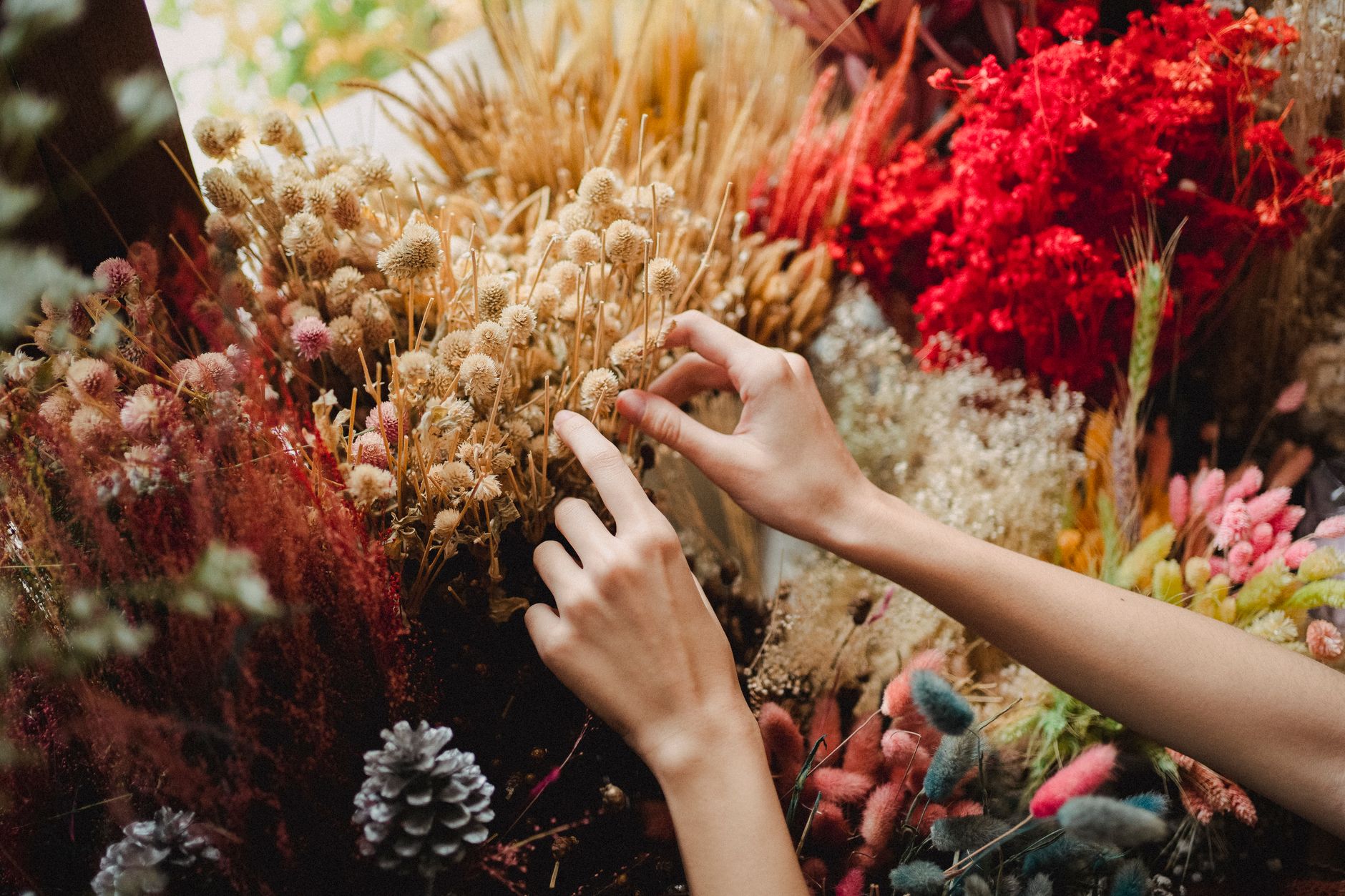
What flowers will you actually touch and arrange?
You'll work with whatever is fresh and in season when you arrive. In Vietnam, that might include local chrysanthemums, gladiolus, roses from Da Lat, green foliage like ruscus or leather leaf, and tropical stems such as anthurium or ginger flower. We don't use rare or protected species. You'll learn to strip lower leaves (so they don't rot in water), split woody stems with a knife, and cut at a 45-degree angle for water absorption. You might arrange a hand-tied bouquet, a vase arrangement, or a low table piece—we choose based on the group's pace and interest. Most guests leave with their own finished piece wrapped in brown paper and a small pack of flower food.
How does skill level actually affect what you make?
Beginners often think "florist = years of training." In reality, your first session teaches the fundamentals: proportion, negative space, and the fact that odd numbers of stems look more natural than even. We show you the classic triangular shape (tall back, shorter sides, flowers at varying depths) and then let you bend it. An experienced gardener might experiment with asymmetrical lines; a teenager often surprises us with bold color choices; someone with no plant knowledge learns that flowers are alive and drink water, which reframes how they think about the arrangement. Within an hour, almost everyone makes something they'd be happy to give a friend. The second half of the session is about refining: turning stems, removing a leaf that's blocking the view, adding a single stem that suddenly balances the whole piece. We never say "that's wrong"; we ask questions ("What happens if you bring that pink forward?" or "Where does your eye land first?") so you make the choice.
What will the timeline feel like, hour by hour?
Arrival (0–10 min): We greet you, show you where to set down bags, introduce ourselves and the space. You wash your hands.
Demonstration (10–25 min): We talk you through a small arrangement in real time—showing how we choose a vase, place a base of greenery, then add focal flowers (the big, eye-catching ones), filler, and line material. We name the parts. You ask questions; there are no dumb ones.
Your turn (25–90 min): You stand at your table with stems, a vase, water, and scissors. We circulate constantly. Most people work in pairs or small groups so you can chat, help each other reach stems, and share the moment. Kids often race; we slow them down with a funny comment and suggest they step back every five stems to look. Seniors appreciate a stool if they need one; we always have one nearby.
Finishing & wrapping (80–100 min, or 120 min in longer sessions): We mist your arrangement, teach you the aftercare (cut the stems again at home, fresh water daily, avoid direct sun and fruit), wrap it in paper or a simple box, and take a group photo if you want. You carry it out.
How do we adapt for children, older adults, and dietary needs?
For kids (6–16 years): Shorter arranging surfaces; pre-cut stems in smaller lengths; wider vases (harder to knock over); we assign one adult per 2–3 kids for safety. They often create messier, more creative pieces—we celebrate that. Sessions with families usually trim to 90 minutes so patience doesn't wear thin.
For older adults: We pre-prepare many stems so there's less repetitive cutting and stripping. We offer a tall stool or chair so you're not bending to a low table. We slow the pace, allow more time to talk about what you're doing, and sometimes suggest a simpler design so the focus is joy, not wrestling with fifteen stems. Arthritis or tremor? We'll hold the vase steady or prepare the water and stems more, keeping you in full creative control.
For allergies: We ask on WhatsApp before your session. If you're sensitive to pollen, certain flowers (like lilies) can go straight into your vase without you handling the stem, or we swap them entirely. If you have a latex allergy, we skip gloves.
For dietary needs: Our sessions don't include food, so there's no risk there—but if you're joining a combined experience like a cooking class or street food tour, we plan menus in advance.
For rain: Vietnam's humidity and occasional downpours don't stop us. The workspace is covered. We've run sessions while rain drums on the roof; it's atmospheric. Flowers don't mind water—they're supposed to be wet. You might get damper than expected, so bring a small towel if you're precious about your hands.

What's the honest checklist before you book?
- Do you want to make something you'll keep? Our sessions are hands-on; you leave with a real arrangement. If you prefer to watch a demo, this isn't it.
- Are you willing to get your hands wet and a bit messy? Flower arranging = water, pollen, torn leaves, dirt. We have a sink and paper towels, but you'll feel like you've worked.
- Do you have 2–3 hours free? Rushing through doesn't work. If you're jet-lagged or on a tight schedule, it's better to reschedule.
- Can you carry a wrapped arrangement home safely? If you're backpacking with no room, we'll wrap it very carefully, but you need to get it back to your accommodation in one piece. Public transport is fine if you hold it upright.
- Are you okay being in a real florist's space, not a polished classroom? There's no AC in some spaces; it's humid. Flowers sometimes bruise or fall apart—that's real life, not a failure.
- Do you want to learn florist secrets, or just have fun? Both are valid. Let us know your vibe, and we'll pitch the conversation accordingly.
Comparison: Floristry Class vs. Other Hands-On Experiences
| Experience | Duration | Group size | What you take home | Skill level | Best for |
|---|---|---|---|---|---|
| Floristry class | 2–3 hrs | 2–8 | Your arrangement (30–40 cm) | Beginner–intermediate | Decorating home, gifts, learning design |
| Coffee workshop | 1.5–2 hrs | 2–8 | 2–3 cups you made | Beginner–intermediate | Understanding taste, roasting, brewing |
| Cooking class | 3–4 hrs | 2–8 | Lunch/dinner you cooked | Beginner–advanced | Feeding yourself, family meals |
| Tea experience | 1.5–2 hrs | 2–8 | Tea knowledge, calm | Beginner | Relaxation, tasting, ceremony |
What happens if you've never arranged a flower in your life?
This is the most common scenario, and we've learned to recognize the anxiety: "I'll kill the flowers" or "I'm not creative." In the first five minutes, we show you that a stem in water is almost impossible to kill—it'll drink for a week if you let it. We explain that "florist" is a job title, not a mystical gift. You have two eyes and hands; you can see color and hold scissors; that's 90% of what you need. The other 10% is permission to try, fail, adjust, and try again. No one in our sessions has ever made something they regretted. The worst you'll end up with is a slightly wonky vase arrangement that still looks like flowers in water, which is exactly what flowers are supposed to be.
Why book with Cáo Experiences instead of a local florist?
Local florists are magnificent craftspeople—but they're usually rushing to fill orders. We've set aside time specifically for you to learn. We speak English. We're organized via WhatsApp, so you can ask questions before you arrive, confirm the date, share dietary or mobility needs, and see photos of past sessions. We know which flowers are in season, which florists have the best stock, and how to pace a session so beginners feel safe and confident. We've hosted families, couples on dates, groups of expats, solo travelers, and company teams. Visit our flower arranging page to see what's available in your city.
Book your floristry class now | Explore more hands-on experiences
What to check before you book
- Confirm the date and group size. We run sessions on request; we need at least 5 days' notice. Smaller groups (2–3 people) are intimate; larger groups (6–8) are fun and cost less per person.
- Ask about the flower selection. Tell us if you hate certain colors or love certain blooms. We'll work with what's available, but we can steer toward your preferences.
- Know what you're wearing. Water splashes. Wear clothes you don't mind getting damp and shoes with grip (not flip-flops—wet floors are slippery). Bring a light scarf or cardigan if you're sensitive to cold.
- Plan transport home. Your arrangement will be wrapped, but it's not indestructible. A taxi is safer than a motorbike if you're not used to balancing things. Buses work if you hold it upright.
- Arrive 10 minutes early. Punctuality is respect; we do the same. If you're running late, message us so we're not waiting.
- Ask about combining experiences. Many guests pair a floristry class with a coffee workshop or a visit to the flower market the same morning. We can coordinate that.

FAQ
Do I need any experience to join a floristry class?
No. Most guests have never arranged flowers professionally. We teach you the basics in the first 20 minutes, and you'll make a real, beautiful arrangement by the end. Confidence builds as you work.
What happens to my arrangement after I make it?
You take it home wrapped. At home, recut the stems at a 45-degree angle, put them in fresh water, and change the water every 2–3 days. A well-made arrangement lasts 7–10 days if the flowers are fresh. We give you flower food and detailed care instructions on the day.
Can I bring a friend or family member?
Yes. We encourage pairs and small groups. Friends often help each other, share stems, and make the experience more relaxed. Group sizes max out at 8 so everyone gets enough attention.
What if I'm allergic to pollen or flowers?
Tell us before you book. We can work around lilies and other high-pollen flowers, or we can arrange so you're handling foliage and vase prep while we handle the fragile blooms. Don't let allergies stop you; we'll adapt.
How much does a floristry class cost?
Ask us for dates and a quote on WhatsApp. Price depends on the number of people, which flowers are in season, and group size. Larger groups cost less per person. We're transparent about what's included.
Can kids join, or is it adults only?
Kids 6+ love it. We adjust the height of tables, cut stems shorter, and give them simpler designs so they feel accomplished fast. Sessions with kids trim to 90 minutes. Parents often do their own arrangement alongside.
What if the weather is rainy or very hot?
We run in both. Rain doesn't bother the flowers or the session. Heat is humidity in Vietnam; it's normal. We provide water to drink and fans if the space gets warm. Flowers actually stay fresher in cool, humid air.
Do you offer classes in Hanoi, Ho Chi Minh City, Hoi An, and Da Nang?
Yes. We host in Hanoi, Ho Chi Minh City, Hoi An, and Da Nang. Availability depends on the season and our schedule. Ask us which dates work in your city.
Ask about dates
Tell us the city, your dates and what you would like to try. We reply on WhatsApp in English with options and availability.
FAQ
Do I need any experience to join a floristry class?
No. Most guests have never arranged flowers professionally. We teach you the basics in the first 20 minutes, and you'll make a real, beautiful arrangement by the end. Confidence builds as you work.
What happens to my arrangement after I make it?
You take it home wrapped. At home, recut the stems at a 45-degree angle, put them in fresh water, and change the water every 2–3 days. A well-made arrangement lasts 7–10 days if the flowers are fresh. We give you flower food and detailed care instructions on the day.
Can I bring a friend or family member?
Yes. We encourage pairs and small groups. Friends often help each other, share stems, and make the experience more relaxed. Group sizes max out at 8 so everyone gets enough attention.
What if I'm allergic to pollen or flowers?
Tell us before you book. We can work around lilies and other high-pollen flowers, or we can arrange so you're handling foliage and vase prep while we handle the fragile blooms. Don't let allergies stop you; we'll adapt.
How much does a floristry class cost?
Ask us for dates and a quote on WhatsApp. Price depends on the number of people, which flowers are in season, and group size. Larger groups cost less per person. We're transparent about what's included.
Can kids join, or is it adults only?
Kids 6+ love it. We adjust the height of tables, cut stems shorter, and give them simpler designs so they feel accomplished fast. Sessions with kids trim to 90 minutes. Parents often do their own arrangement alongside.
What if the weather is rainy or very hot?
We run in both. Rain doesn't bother the flowers or the session. Heat is humidity in Vietnam; it's normal. We provide water to drink and fans if the space gets warm. Flowers actually stay fresher in cool, humid air.
Do you offer classes in Hanoi, Ho Chi Minh City, Hoi An, and Da Nang?
Yes. We host in [Hanoi](/destinations/hanoi), [Ho Chi Minh City](/destinations/ho-chi-minh-city), [Hoi An](/destinations/hoi-an), and [Da Nang](/destinations/da-nang). Availability depends on the season and our schedule. Ask us which dates work in your city.
More like this
Flower arranging workshops
Flower Arranging Workshop Ho Chi Minh City: How to Book
A flower arranging workshop in Ho Chi Minh City teaches you to design seasonal arrangements in a calm studio setting. We run small-group and private sessions with English-speaking hosts who walk you through technique, flower choice, and how to make arrangements last.
Flower arranging workshops
Flower arranging workshop in Ninh Binh for couples
A flower arranging workshop in Ninh Binh lets couples create an arrangement together in a calm setting, learning Vietnamese design principles while working with seasonal blooms.
Flower arranging workshops
Flower Arranging Workshop in Mekong Delta for Foreigners
We run intimate flower arranging workshops in family-owned gardens and workshops across the Mekong Delta, where you'll learn seasonal design by practicing alongside our hosts. Pick your own blooms, arrange three pieces, and take them home.