 Cáo Experiences
Home › Blog › Flower arranging workshops
Flower arranging workshop in Vietnam: how to book with Cáo
By the Cáo Experiences team · 2026-11-01
A flower arranging workshop with Cáo Experiences runs 2–3 hours in a family kitchen or light-filled studio in Hanoi, Hoi An, Da Lat, or Da Nang. You work with fresh, seasonal Vietnamese flowers—chrysanthemums, roses, orchids, celosia—guided by a host who handles translation and teaches posture, stem-cutting angles, proportion, and color balance. Groups are 2–6 people. No experience needed; beginners worry about "making it pretty," but we start with basic mechanics (spiral grip, floral foam prep) and show you the repetition and rhythm that matter more than perfectionism. Bring an open mind and comfortable clothes; we provide all flowers, tools, and vessels. You take your arrangement home same day. To book with Cáo Experiences, send us dates and group size on WhatsApp or contact us directly—we'll confirm availability, answer diet/mobility questions, and tell you the rate. Rain doesn't stop us; we shift indoors or reschedule. Kids (8+) and seniors (any age) do well; we adapt pace and technique. Ask about dates and pricing based on season and location. Ask about dates on WhatsApp
What actually happens in a 2-hour flower arranging class?
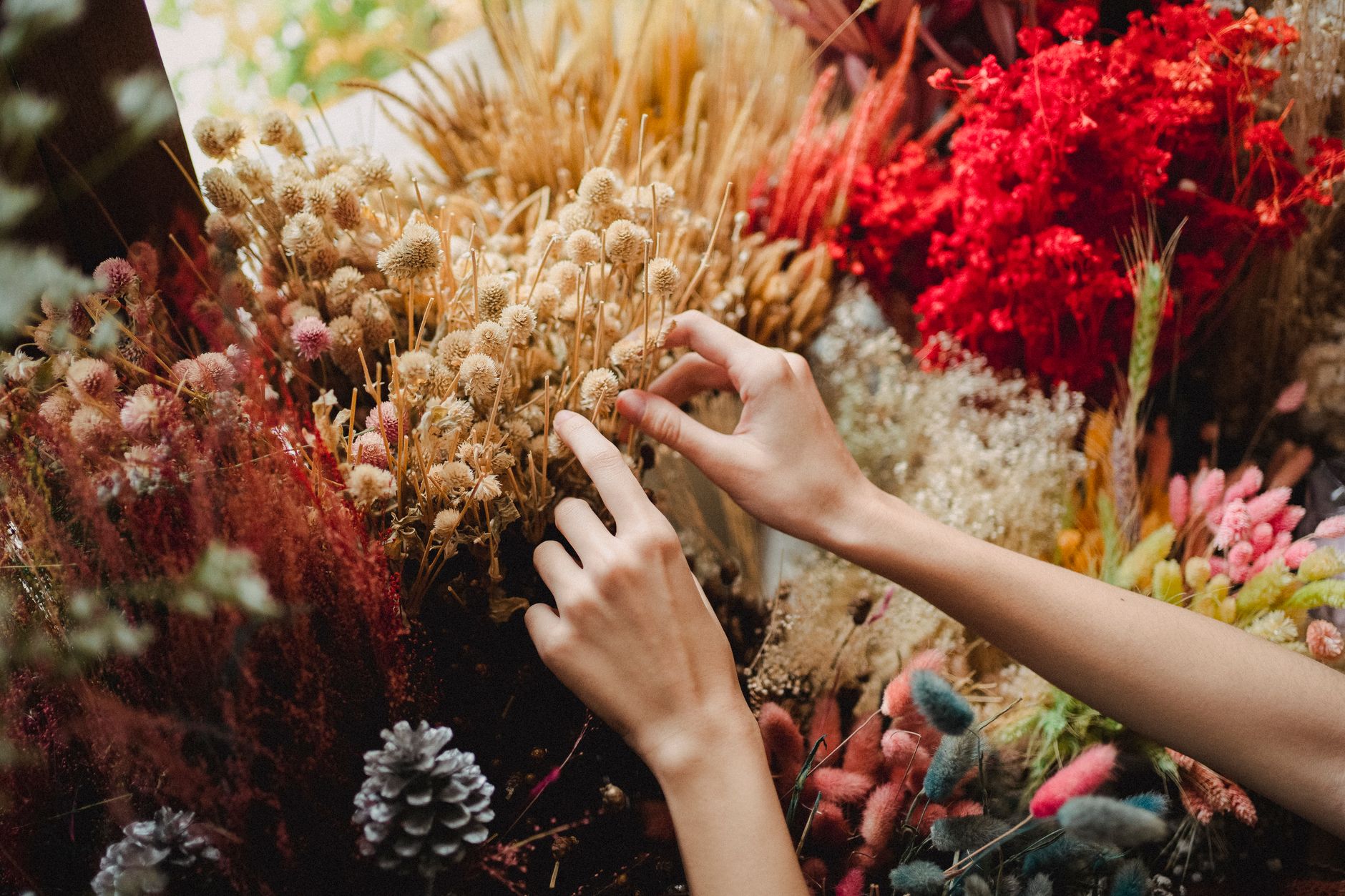
You arrive at the studio or home kitchen about 10 minutes early. We lay out flowers on a long table—bunches of fresh stems still in water. You choose your color palette: soft pastels, jewel tones, or mixed. The host walks through the setup while someone brews tea. First 20 minutes: we teach the spiral technique on a practice stem, show you how to strip leaves, angle cuts at 45 degrees under running water (longer stems drink better). You try it, feel the flex of a rose stem, notice which angle lets water travel up. Then floral foam: we soak it, show you how to anchor it in your vessel without crushing it. This matters because foam is your grid; bad prep means flowers droop by evening. Next 60 minutes: you build. Start with greenery (eucalyptus, salal, or local filler), establish height and width, then layer flowers by size—largest first, smallest last to fill gaps. The host circulates, adjusts your hand position, suggests a stem rotation or a gap to fill. You're not following a template; your arrangement reflects your choices, but we catch imbalance early. Last 20 minutes: final tweaks, photos, a quick lesson in home care (change water every two days, trim 1 cm off stems daily, keep out of direct sun). You wrap your arrangement in tissue, carry it home carefully.
See the full flower arranging experience

Why do beginners worry about perfection, and what should they expect instead?
Most people arrive thinking "I'm not artistic" or "mine will look messy." They compare themselves to Instagram florals—tight, symmetrical, magazine-cover perfect. In reality, design is a language you learn: ratio (height should be 1.5× your vessel), balance (visual weight, not symmetry), and color story (what colors sit next to each other). We teach that a "loose" garden style or a slightly asymmetrical modern arrangement is technically sound and often more interesting than rigid perfection. By hour two, you've made dozens of micro-decisions—which stem goes left, how far to separate clusters—and your hand remembers the spiral. Your first arrangement won't look like a florist's, and that's the point: it looks like you made it, and it's alive and will last a week. We celebrate that. Beginners leave surprised at how technical and meditative the work is, not stressful.
Where can you take a flower arranging workshop in Vietnam?
We run workshops in four locations: Hanoi (a family kitchen in a quiet lane, or a light studio near the old quarter), Hoi An (a peaceful space in or near the ancient town), Da Lat (a cooler mountain setting, excellent for seasonal temperate flowers), and Da Nang (a modern coastal studio). Each location offers the same core class but with different flower varieties based on season and local growing. Hanoi and Hoi An run year-round; Da Lat and Da Nang adapt to regional harvests. Explore experiences in Hanoi, Hoi An, Da Nang, and Da Lat to see what's available near you.
What should you bring, wear, and prepare for?
Wear comfortable, clean clothes you don't mind getting water or flower pollen on—floristry is not messy, but accidents happen. Bring a phone to photograph your work. Leave perfume at home; it competes with flower scent and can be jarring indoors. If you have fragrance allergies or latex sensitivities (we use some rubber bands and floral foam occasionally), tell us when you book so we source alternatives. Bring curiosity and a willingness to try a stem twice if the first attempt doesn't feel right. We provide: fresh flowers, floral foam, florist tape, sharp knives, vessels (a low cylinder, a tall vase, or a shallow bowl—you choose or we assign), water, and instruction. No tools to buy or rent.
How do you actually book, and what happens next?
Reach out to us on WhatsApp with your preferred dates, number of people (2–6 for group; private classes available for larger groups), and location. We'll confirm whether that date has availability and tell you the rate. We'll ask: any dietary needs if we're providing a light snack, mobility concerns, age of any children, language preference (we host in English; translation support available for other languages). You'll get a confirmation message with the exact time, address, and what to bring. Two days before, we send a reminder and a photo of the flowers we've sourced that week so you can plan your color choice. We can shift the date if rain is severe, though light rain won't stop us—we have an indoor space. On the morning of the class, arrive about 10 minutes early. After the class, we'll ask you to rate the experience and tell us what flowers you used so we can suggest next time: "You loved celosia—want to try it in autumn tones?" We keep a loose record of who you are and what you prefer, so a returning guest gets a slightly tailored class.
How does a flower arranging workshop compare to other hands-on experiences in Vietnam?
| Experience | Duration | What you learn | Best for | Take home |
|---|---|---|---|---|
| Flower arranging | 2–3 hrs | Design, posture, spiral technique, color theory | Visual learners, anyone | Fresh arrangement (1 week life) |
| Vietnamese cooking class | 3–4 hrs | Technique, ingredients, 3–4 dishes from scratch | Hungry travelers, families | Food you ate, skill |
| Coffee workshop | 2–3 hrs | Bean origin, roast, brew methods, tasting | Coffee enthusiasts, detail-focused | Beans, new brewing habit |
| Craft workshops | 2–3 hrs | Traditional technique (silk, lacquer, embroidery) | Culture seekers, gift-makers | Handmade keepsake |
| Tea experiences | 2–3 hrs | Tea history, ceremony, water, mindfulness | Relaxation-focused, curious | Tea knowledge, calm |
Each is tactile and small-group. Flower arranging is the fastest to see results (your finished piece in 2 hours) and works well alongside farm and countryside experiences if you're exploring rural Vietnam, or art and culture classes if you're into visual creativity.
What happens if the weather is bad, and how do we adapt for kids and seniors?
Rain. Light drizzle? We continue indoors. Heavy rain that makes travel unsafe? We reschedule to the next available slot—no fee. We choose indoor venues precisely for this; even a "garden setting" class has a roof or covered porch.
Kids (ages 8–12). They work at a lower table with slightly shorter vessels. We skip the spiral grip (too fiddly) and teach them to cluster stems in foam, focusing on color and fun. A parent often joins; some arrangements become joint projects. Kids finish faster—maybe 90 minutes—and love taking home something alive.
Teenagers (13+). Same class as adults; they often surprise themselves with design instincts.
Seniors (any age). We raise the work table, ensure good lighting, and take breaks every 45 minutes. If arthritis or grip concerns exist, we adapt: a host may help with heavy stem-cutting while the guest focuses on placement and design. Pace never feels rushed.
Allergies. Pollen sensitivity? We use low-pollen varieties (roses, dahlias) and keep them at arm's length. Latex allergy? We skip rubber bands and use string or tape. Ask us when you book.
What to check before you book
- Dates. Our calendar fills; book 2–3 weeks ahead if possible. Last-minute (3 days or fewer) may not have slots.
- Group size. 2–6 is standard. Larger groups (8+) are possible privately; ask about cost and logistics.
- Seasonal flowers. Summer brings garden roses and dahlias; winter, chrysanthemums and evergreens. Your final palette depends on what's growing that week—we can't guarantee a specific color, but we'll work with you.
- Physical setup. If you have mobility or back issues, confirm the table height and seating during booking.
- Fragrance. Flower scent is intense in a small room. If you have scent sensitivity, let us know so we ensure good ventilation.
- Duration. 2 hours is standard; 3 hours available for private groups who want slower pace or multiple arrangements.
Ask about booking your workshop

FAQ
Do I need prior flower arranging experience?
No. We teach from the ground up—posture, grip, stem prep, foam setup. Beginners often finish as confident as they need to be in 2 hours.
What if my arrangement doesn't last long after I take it home?
Tap the foam daily, refresh the water, trim stems 1 cm, keep out of direct sun. A well-made arrangement lasts 7–10 days. If it wilts in 2 days, it's likely the water wasn't changed or the stems weren't cut fresh. We review care during the class.
Can I do a flower arranging class with friends, or is it private?
Both. Small groups (2–6) run on set dates; we coordinate with others booking the same day. Private classes for your group (8+) can be scheduled separately. Ask which suits you.
What if I hate flowers or have strong allergies?
A flower workshop isn't for you. Explore our craft workshops, art classes, or cooking class instead—same hands-on, small-group format, different focus.
How far in advance should I book?
2–3 weeks is ideal. We can sometimes squeeze in last-minute bookings (3–5 days), but don't rely on it. WhatsApp us your dates and we'll confirm immediately.
Can I book a private class for a birthday or special event?
Yes. Private classes are custom—larger groups, longer duration, themed flowers, a celebration meal before or after. Contact us for a quote tailored to your event.
Ask about dates
Tell us the city, your dates and what you would like to try. We reply on WhatsApp in English with options and availability.
FAQ
Do I need prior flower arranging experience?
No. We teach from the ground up—posture, grip, stem prep, foam setup. Beginners often finish as confident as they need to be in 2 hours.
What if my arrangement doesn't last long after I take it home?
Tap the foam daily, refresh the water, trim stems 1 cm, keep out of direct sun. A well-made arrangement lasts 7–10 days. If it wilts in 2 days, it's likely the water wasn't changed or the stems weren't cut fresh. We review care during the class.
Can I do a flower arranging class with friends, or is it private?
Both. Small groups (2–6) run on set dates; we coordinate with others booking the same day. Private classes for your group (8+) can be scheduled separately. Ask which suits you.
What if I hate flowers or have strong allergies?
A flower workshop isn't for you. Explore our [craft workshops](/craft-workshops), [art classes](/art-classes), or [cooking class](/cooking-class) instead—same hands-on, small-group format, different focus.
How far in advance should I book?
2–3 weeks is ideal. We can sometimes squeeze in last-minute bookings (3–5 days), but don't rely on it. WhatsApp us your dates and we'll confirm immediately.
Can I book a private class for a birthday or special event?
Yes. Private classes are custom—larger groups, longer duration, themed flowers, a celebration meal before or after. Contact us for a quote tailored to your event.
More like this
Flower arranging workshops
Flower Arranging Workshop Ho Chi Minh City: How to Book
A flower arranging workshop in Ho Chi Minh City teaches you to design seasonal arrangements in a calm studio setting. We run small-group and private sessions with English-speaking hosts who walk you through technique, flower choice, and how to make arrangements last.
Flower arranging workshops
Flower arranging workshop in Ninh Binh for couples
A flower arranging workshop in Ninh Binh lets couples create an arrangement together in a calm setting, learning Vietnamese design principles while working with seasonal blooms.
Flower arranging workshops
Flower Arranging Workshop in Mekong Delta for Foreigners
We run intimate flower arranging workshops in family-owned gardens and workshops across the Mekong Delta, where you'll learn seasonal design by practicing alongside our hosts. Pick your own blooms, arrange three pieces, and take them home.