
Home › Blog › Experiences for families and kids
Kids cooking class in Vietnam for seniors: multi-generation family experiences
By the Cáo Experiences team · 2026-11-06
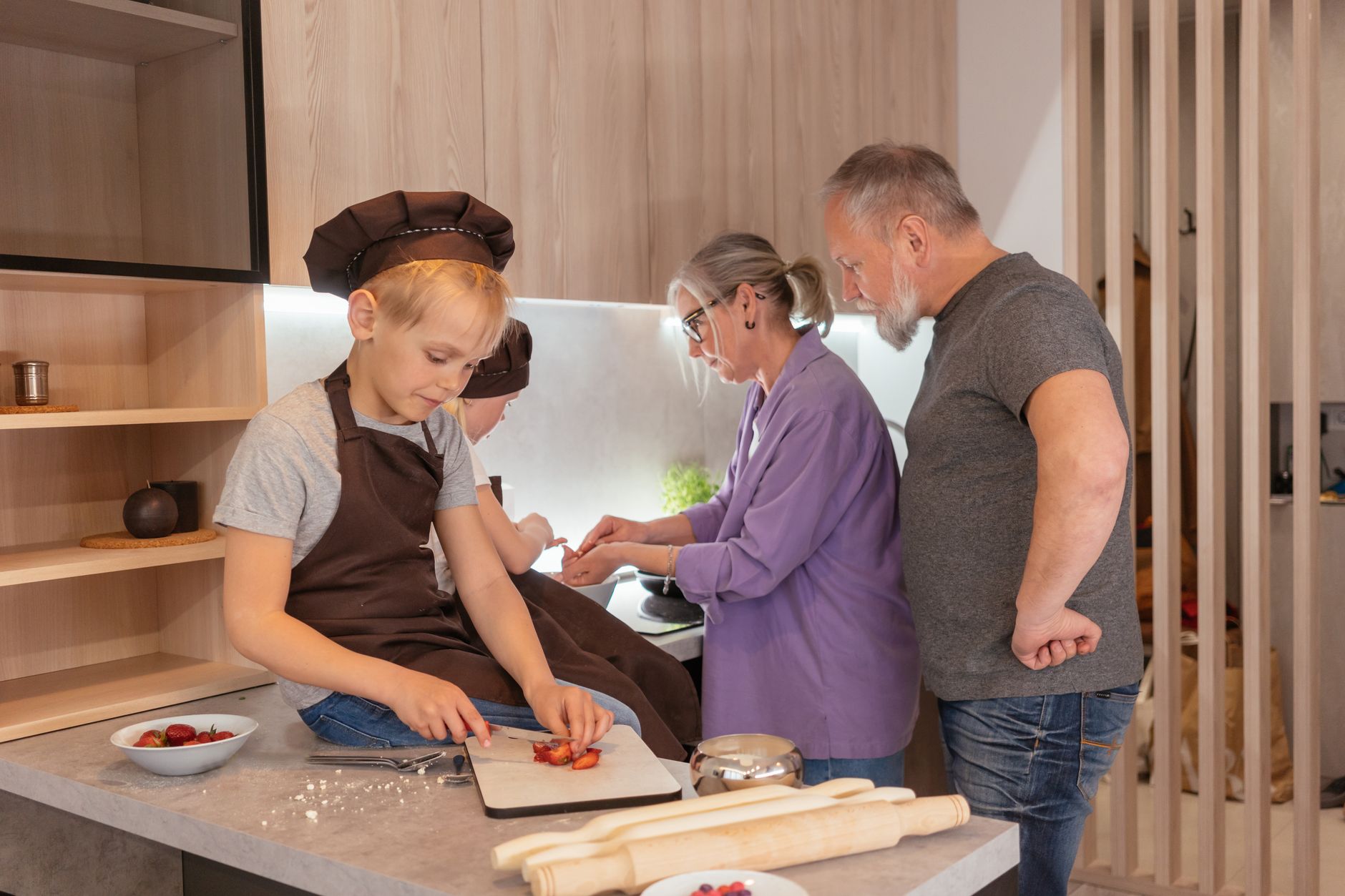
A kids cooking class in Vietnam for seniors is a family experience where children aged 6+ and adults 60+ learn traditional Vietnamese dishes together in a single session. We run these in family-owned kitchens in Hanoi, Hoi An, Da Lat and Ho Chi Minh City, typically 10 a.m. to 1 p.m., with all instruction in English. Each person cooks their own dish (spring rolls, pho broth, banh mi components) at their own pace; we adapt knife work for arthritic hands, step-stool access for shorter reach, and rest breaks without pressure. Sessions include a market walk beforehand to choose ingredients, a light lunch eating what you've made, and printed recipe cards to take home. Ask us for dates and a quote on WhatsApp—pricing varies by location, group size and any dietary needs. What to avoid: booking on humid 35°C afternoons (we reschedule to morning or evening), assuming kids will sit still (they knead, roll and taste throughout), or booking within 48 hours (we need time to arrange the kitchen and brief your group's needs). Ask about dates on WhatsApp
Why grandparents and kids cook better together in Vietnam
When a grandparent steps into a Vietnamese family kitchen alongside a child, both gain something neither learns alone. A senior's steadiness with a mortar and pestle complements a kid's energy kneading dough. Vietnam's cuisine—built on slow-cooked broths, hand-rolled wraps and layered flavors—naturally suits multigenerational rhythm. We've noticed that kids relax when they're not the only learner; seniors regain teaching confidence when they mentor (even a 7-year-old on how to taste for salt). The shared meal at the end—eating something you've both shaped—becomes a memory that lasts far longer than a restaurant meal. Family experiences in Vietnam work best when every person has a clear role and a real outcome.

What happens hour by hour in a mixed-age cooking session
We start at your accommodation or meet at a street food and market tour point (a laneway market in the old quarter, or a neighborhood wet market outside town) around 9 a.m. You walk together, we point out seasonal vegetables, talk about texture and aroma, and you buy what you'll cook. Back at the kitchen—a tiled family room with low counters we adjust with risers for seniors—we wash our hands, tie aprons, and begin.
First 45 minutes: knife skills and prep. We show you how to hold the blade, demonstrate on one item, then you try. Garlic, shallots, greens—each person works at their own speed. Seniors often have steadier hands than expected; kids need a spotter but rarely get hurt. We pause, sit down, drink water.
Next 45 minutes: cooking the main dish. For spring rolls, kids roll while seniors handle the frying pan (or vice versa). For pho broth, seniors infuse the stock while kids arrange noodles and toppings. Every step has a senior-friendly and child-friendly version.
Final 30 minutes: plating, tasting, sitting down to eat. This is unhurried. No rush. You eat what you made, with a fresh herb plate and dipping sauces we've prepared.
How we adapt for arthritis, short reach and attention spans
A 68-year-old with mild arthritis cannot grip a Vietnamese cleaver the same way a 34-year-old can. We don't pretend otherwise. Instead: a lighter knife, a cutting board at elbow height (not counter height), a thick handle wrapped in foam tape, and a partner (often a grandchild) to hold the board steady. A child of 6 cannot reach our standard counter. We use a sturdy step stool, check the stool's stability before they step, and position you—the adult—within arm's reach. A 9-year-old's focus on mincing garlic lasts 12 minutes, not 45. So we rotate roles: "You roll now, Grandpa fries. In 10 minutes, swap." This keeps energy and motivation even. We also build in natural breaks—sitting, tasting, talking—without framing them as "rest time" (which can feel isolating for a senior).
Allergies and dietary limits are factored into the ingredient list before you arrive. Shellfish allergy? We swap fish sauce for soy-based dipping sauce. Diabetes-conscious? We use less sugar in dressings. Vegetarian? We build the session around vegetable-forward dishes like herb rolls and morning-glory stir-fry. We email you a checklist 48 hours ahead: "Check these ingredients—tell us if any are a no."
Rainy weather, heat and how to reschedule without stress
Vietnam's monsoons and tropical heat can derail an outdoor experience, but a cooking class stays indoors. Heavy rain, though, can flood market access or make travel unsafe; we'll suggest rescheduling to the next morning. If the kitchen's neighborhood is under water, we move you to a different kitchen—same instructor, same recipe, same spirit. A 38°C midday session makes both kids and seniors uncomfortable; we automatically shift to 8–11 a.m. or 4–7 p.m. when you book. Heat exhaustion is a real risk. We serve cold water and herbal tea, open windows or run a fan, and never rush cooking steps to "beat the heat"—that's when mistakes (and burns) happen.
Comparison: family cooking class vs. restaurant meal vs. cooking school
| Option | Who it suits | Time commitment | Hands-on? | Personalization | Memory value |
|---|---|---|---|---|---|
| Kids + seniors class with Cáo | Mixed ages, limited mobility, no prior skill | 3 hours | 90% cooking, 10% instruction | High: adapted to your group's needs and pace | Very high: you made it, you ate it together |
| Restaurant meal + food tour | Any age, mobility OK | 2–3 hours | 0% (eating) | Low: fixed menu, passive | Medium: nice meal, limited learning |
| Formal cooking school (1-week course) | Adults only, weeklong stay | 30+ hours | 80% cooking | Medium: standardized curriculum | High: deeper skill, less personal family time |
The kids and seniors mixed class uniquely balances engagement, memory and practical skill for short-stay families. You don't need prior cooking knowledge, you're not sitting passively, and you leave with recipes and muscle memory.
What to check before you book your family cooking session
Mobility and reach: Does any senior need a cane or walker? Tell us—the kitchen has level flooring and we can arrange seating for prep. Does your youngest child climb? We'll lock the spice cabinet. Confirm before booking.
Dietary red lines: Not just allergies—aversions count too. If Grandma won't eat shrimp and your 8-year-old is vegetarian, we design the whole session around that reality. List these on WhatsApp.
Group size: Fewer than 2 people? We may suggest joining an open group (mixed travelers + your family) so the social energy stays high. More than 8? We run two sessions back-to-back or bring a co-host.
Location: Different Vietnamese cities offer different cuisines and seasonality. Hanoi excels in pho and hand-cut noodles. Hoi An specializes in cao lau and soft turmeric cakes. Da Lat centers on vegetable-forward cooking and temperate-zone herbs. Ask us which location matches your group's interests.
Language: We host in English. If you speak Vietnamese at home, your child may switch between languages—that's fine and common. We won't force English-only; code-switching happens naturally in family moments.
Other experiences that pair well with a cooking class
A Vietnamese coffee workshop (1.5 hours, no heat risk, seniors love the sitting-down ritual) and a cooking class can run back-to-back on the same morning. A farm and countryside experience in the morning—picking herbs, learning about seasonal greens—can feed directly into a cooking class in the afternoon (you pick the herbs, you cook them). A flower arranging workshop (standing, artistic, 90 minutes) works as a gentler afternoon activity after a morning cooking class. A tea experience can replace coffee if any family member avoids caffeine. We can help you thread these group and corporate experiences into a coherent itinerary over 2–3 days.

FAQ
What if a grandparent has never cooked Vietnamese food before?
Neither has most of our guests. We start from "here's a mortar, here's how to grip it" and build from there. Experience helps—a retired chef cooks faster—but we scale instruction to each person's baseline, not their background. You'll make something recognizable and delicious on your first try.
Can we do this as a private family group or does it have to be mixed with strangers?
Both happen. A private session is your family alone (15–20 people max in one kitchen, realistically 4–8 for comfort). An open group mixes families and travelers—kids often make friends, seniors share stories. Ask us on WhatsApp which option is available for your dates and location.
How do we get the recipes home? Are they in English?
Yes. We print or email step-by-step recipe cards in English after your session, with ingredient lists and substitutions for items unavailable outside Vietnam. We also photograph your dishes so you have visual reference at home.
What if someone burns themselves or gets a minor cut in the kitchen?
We keep a first-aid kit, apply pressure and cool water immediately, and wrap properly. Burns and cuts happen in kitchens everywhere. We've treated hundreds; it's rare and manageable. Serious injury (deep cut, severe burn) would mean a trip to a nearby clinic—we know the closest one and can accompany you. Honest: this is a small occupational risk in any hands-on cooking class.
How much walking is involved in the market part?
Usually 15–25 minutes total—not a "tour," more a gentle stroll to the vendor stalls you need. We stop, we look, we talk. If walking is difficult for a senior, we can arrange for a family member to walk ahead with a list, or in some markets, a motorbike taxi will take you close to the stall and back. Tell us about mobility limits when you book.
Can we do a cooking class if someone is vegetarian and another person eats meat?
Absolutely. We design the menu around both. One person cooks a vegetable-based dish (stir-fried greens, tofu wraps), another cooks a meat version of the same base recipe (same techniques, different protein). Both eat both, or just their own—no judgment. This actually teaches kids and seniors how to cook inclusively, which is a real-world skill. --- Ask about dates on WhatsApp | See how a session runs For more hands-on family experiences in Vietnam, visit our main experiences page or read more stories from our hosts.
Ask about dates
Tell us the city, your dates and what you would like to try. We reply on WhatsApp in English with options and availability.
FAQ
What if a grandparent has never cooked Vietnamese food before?
Neither has most of our guests. We start from "here's a mortar, here's how to grip it" and build from there. Experience helps—a retired chef cooks faster—but we scale instruction to each person's baseline, not their background. You'll make something recognizable and delicious on your first try.
Can we do this as a private family group or does it have to be mixed with strangers?
Both happen. A private session is your family alone (15–20 people max in one kitchen, realistically 4–8 for comfort). An open group mixes families and travelers—kids often make friends, seniors share stories. Ask us on WhatsApp which option is available for your dates and location.
How do we get the recipes home? Are they in English?
Yes. We print or email step-by-step recipe cards in English after your session, with ingredient lists and substitutions for items unavailable outside Vietnam. We also photograph your dishes so you have visual reference at home.
What if someone burns themselves or gets a minor cut in the kitchen?
We keep a first-aid kit, apply pressure and cool water immediately, and wrap properly. Burns and cuts happen in kitchens everywhere. We've treated hundreds; it's rare and manageable. Serious injury (deep cut, severe burn) would mean a trip to a nearby clinic—we know the closest one and can accompany you. Honest: this is a small occupational risk in any hands-on cooking class.
How much walking is involved in the market part?
Usually 15–25 minutes total—not a "tour," more a gentle stroll to the vendor stalls you need. We stop, we look, we talk. If walking is difficult for a senior, we can arrange for a family member to walk ahead with a list, or in some markets, a motorbike taxi will take you close to the stall and back. Tell us about mobility limits when you book.
Can we do a cooking class if someone is vegetarian and another person eats meat?
Absolutely. We design the menu around both. One person cooks a vegetable-based dish (stir-fried greens, tofu wraps), another cooks a meat version of the same base recipe (same techniques, different protein). Both eat both, or just their own—no judgment. This actually teaches kids and seniors how to cook inclusively, which is a real-world skill. --- [💬 Ask about dates on WhatsApp](https://wa.me/84338762340) | 🍜 See how a session runs For more hands-on family experiences in Vietnam, visit our main experiences page or read more [stories from our hosts](/blog).
More like this
Experiences for families and kids
Family workshop Vietnam vs Thailand: where to take kids in 2026
Vietnam and Thailand both offer immersive family workshops, but the pace, cost structure, and focus differ significantly. We run both types of sessions at Cáo Experiences and can help you choose.
Experiences for families and kids
Family Workshop Vietnam Gift Voucher: What Works Best
A family workshop gift voucher in Vietnam lets relatives experience cooking, craft, horse riding or tea together—no tickets, no queues, real hands-on time. We help you pick the right session type and duration for the ages and interests in your group.
Experiences for families and kids
Family workshops in Vietnam for Indian travelers: what to expect
Indian families visiting Vietnam often wonder how to keep children engaged and learn something authentic together. Cáo Experiences runs small-group and private workshops—cooking, coffee, flower arranging, craft, and farm days—designed for kids, parents, and grandparents, hosted in English with real