
Home › Blog › Experiences for families and kids
Kids Cooking Class in Vietnam: Is It Worth It?
By the Cáo Experiences team · 2026-11-06
A kids' cooking class in Vietnam—run by Cáo Experiences in Hanoi, Saigon, Hoi An, and Da Nang—is a three- to four-hour hands-on session where children (ages 6–16) learn to prepare 2–3 Vietnamese dishes from scratch in a family kitchen or dedicated workshop space. They shop for fresh ingredients at a local wet market, handle a pestle and mortar, stir a wok under host guidance, and eat their own meal. Classes cost differently by city and group size—ask us for dates and a quote on WhatsApp. Worth it? Yes, if your child sits still for 90 minutes, enjoys eating, and you want a memory stronger than a souvenir. Not necessary if your child is picky with unfamiliar textures or if you have fewer than three days in-country. Ask about dates on WhatsApp
What actually happens hour by hour?
A typical session opens at 9 or 10 a.m. in a family kitchen located down a quiet lane or in a workshop space outside the tourist center. We greet your group (2–12 children, or a mix of kids and adults). The host explains the day's menu—usually one soup, one main course, one fresh roll or dessert—using photos, real ingredients laid out on a table, and simple English. Kids wash hands and tie on aprons.
Then: market walk (30–45 minutes). We walk to a neighborhood wet market—not the famous tourist market, but a real one where locals shop. Children see live herbs they've never named, smell fermented fish paste, watch vendors weigh rice, and pick out their own basil and chili. A host points out which stalk is which and why. Kids carry their own small baskets or bags. If a child is anxious in crowds, we can pre-shop or shop in a quieter local grocer instead.
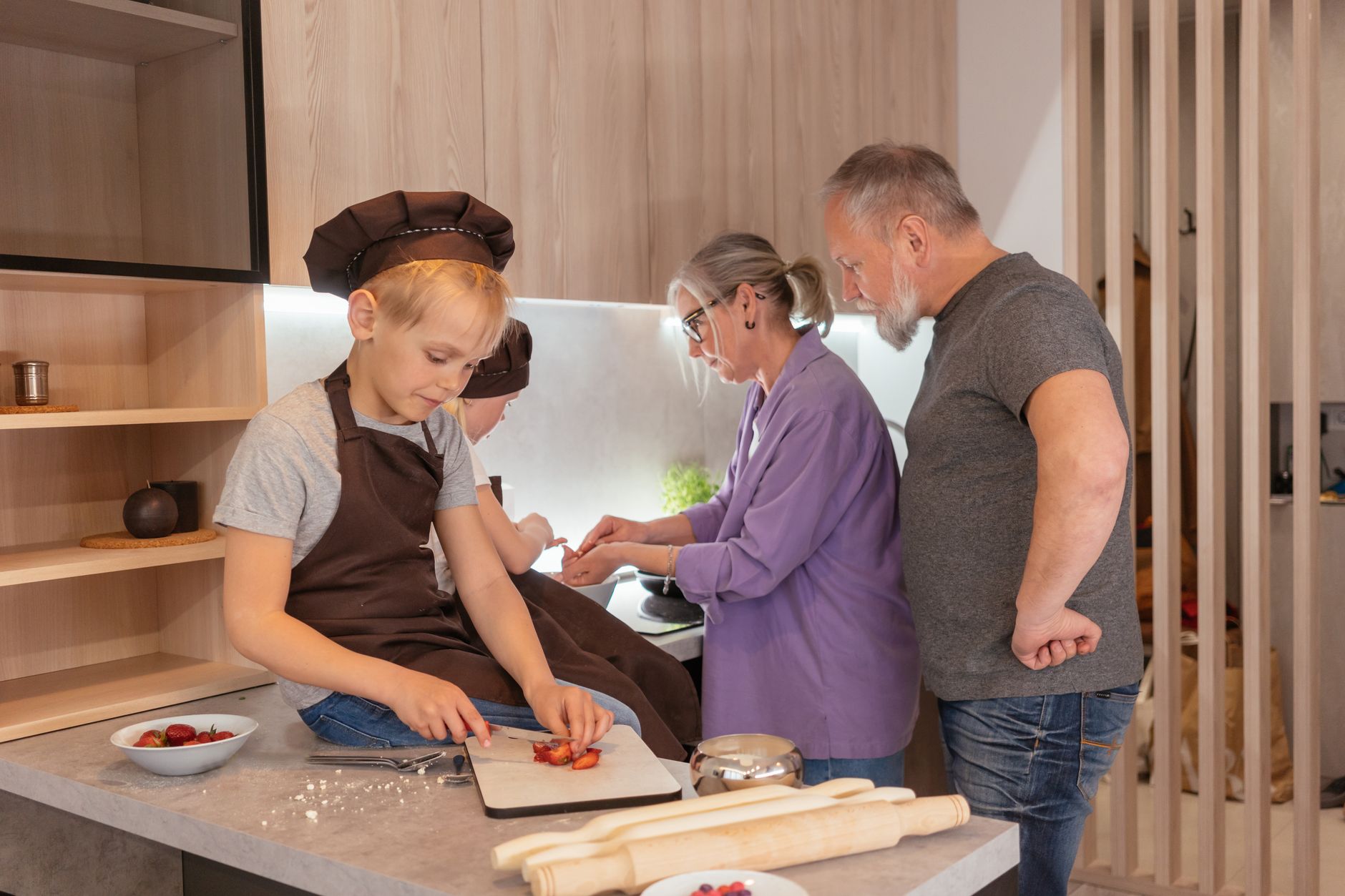
Back in the kitchen: children prep (15 minutes)—peeling garlic, snapping long beans, tearing herbs—at a child-height counter or a table with cushions. A host stands nearby; safety is strict. Wok work (20–30 minutes) comes next: one or two kids at a time stand at the cooktop under close supervision, stirring while the host holds the pan steady and calls out timings. The heat is real, the sizzle is real, the pride is real.
Eating (30 minutes) happens at a shared table. Children taste their own food first, then try dishes made by other kids in the group. We don't force anything; a "no thank you" is fine. Most kids try at least one new thing.
Cleanup is part of it too—teaching that cooking includes tidying—then a goodbye photo and recipe card to take home.

How do kids actually respond to unfamiliar flavors?
Most children are braver in a cooking class than at a restaurant table. They've touched the herb, smelled it raw, seen it go into the pan, and watched it change. Ownership matters. A child who wouldn't eat coriander at home often tastes it here because they cooked it.
That said, we meet kids exactly where they are. If a child says "I don't eat fish," we don't serve them fermented fish sauce on a spoon. Instead, a host might say: "This is a smell people in Vietnam have grown up with since they were babies. You don't have to taste it, but you can smell it from across the room—just to know." Some kids lean in; some don't. Both are fine.
Picky eaters often do best in a Vietnamese cooking class because the environment is playful and the adult pressure is zero. A host is there to teach technique, not force a clean plate.
Which age group gets the most out of it?
| Age | Engagement | Physical Ability | What works best |
|---|---|---|---|
| 6–8 | High curiosity, short focus | Needs step-stool, lighter tasks | Prep work, smelling herbs, eating. Host does the wok. |
| 9–12 | Peak enthusiasm, independent | Can reach counters, follow multi-step tasks | Full cooking—peeling, stirring, tasting their own creation. |
| 13–16 | Variable; some bored, some absorbed | Adult-level strength and safety sense | Wok work, market negotiation, learning why flavors work. |
Children under 6 can join with a parent or guardian, but they tire quickly. Teenagers sometimes roll their eyes at first, then get genuinely interested once they're holding a wok. The sweet spot is 9–12.
Does rain cancel it, or do you adapt?
We almost never cancel for rain in Vietnam. Markets run in drizzle, families still cook, and children still learn. Rain can actually make the market more atmospheric—fewer tourists, real locals doing real shopping.
What we do change: if the rain is heavy and flooding risk is real, we can do a pre-market session where a host brings fresh ingredients to the kitchen and teaches prep and cutting techniques while talking through market sourcing. Not ideal, but it works. Wok work happens indoors regardless of weather.
Kids worry about getting wet. We tell them: "You'll dry. It's water." Most adapt fine. Bring a light rain jacket or plan to laugh it off. One group got soaked walking back from a market and spent the rest of the class making jokes about it. That memory stuck harder than a sunny day would have.
How do we adapt for allergies, dietary needs, and fear?
Before booking, we ask: allergies, dislikes, anxieties. A host then builds the menu around that.
Nut allergies: We source ingredients from suppliers we know and prep nut-free items separately, or swap the recipe entirely.
Vegetarian or vegan kids: Vietnamese cuisine has dozens of vegetable-forward dishes. We swap fish sauce for soy, tofu for protein, and build a full meal around what they will eat.
Fear of bugs or markets: We've had children afraid of live crabs in tanks or the bustle of a wet market. Solution: quieter local grocer, or a shorter market walk with the host buying pre-selected items while the child waits at a nearby café (with a parent). No shame, no pressure.
Sensory sensitivities: If a child struggles with strong smells or loud noise, we let a parent know in advance. A smaller group, a less crowded market time, and shorter exposure work. We've run one-on-one sessions for families who needed it.
Is it worth the time and money versus other family activities?
That depends on three things:
- Does your child enjoy hands-on learning? If yes, a cooking class teaches more than a museum tour—muscle memory, cultural literacy, real food knowledge. If your child prefers passive activities, skip it.
- Do you have 3+ days in Vietnam? A cooking class is best savored as part of a slower trip, not squeezed into a 48-hour dash. You want to reflect on it, try the recipe at home.
- Is the cost reasonable for your budget? Ask us for dates and a quote on WhatsApp. A cooking class costs less than a fancy family dinner, and it's a shared memory, not just a meal.
Compare to alternatives: a farm and countryside experience teaches where food comes from; a street food and market tour is lighter and faster but less hands-on; a flower arranging workshop or art and culture classes teach different creative skills. All are worth doing. Cooking class wins if your family's goal is to make something together and taste it warm.
What to check before you book
- Ages of children in your group: Are they all within 3–4 years of each other? Huge age spreads (6 and 15) can mean one group gets bored.
- Dietary needs: List them clearly when you contact us. We need time to source alternatives.
- Market comfort: Does your child panic in crowds? Tell us; we adapt the route.
- Language: Classes are in English with a bilingual host. Kids pick up Vietnamese food names and phrases naturally.
- Kitchen setup: Ask whether the kitchen has step-stools, child-height surfaces, or if the group will gather around one counter.
- Takeaways: Can your family actually cook these dishes at home, or are you eating-focused? Either is fine—just know what you're signing up for.
We also offer group and team experiences if you're traveling with other families, and we run sessions year-round in Hanoi, Saigon, Hoi An, and Da Nang. Check our family experiences page for other options your children might enjoy alongside or instead of cooking.

FAQ
How many kids should be in a group, and can we do a private session?
Groups run 2–12 children; smaller groups mean more individual wok time, larger groups mean more peer energy. Private sessions are available—ask us on WhatsApp for pricing and dates. A private group works best if you have 4+ children or if your group has very different ages and needs.
Can a parent or non-cooking sibling join and just watch?
Yes. Parents often sit at the eating table with a coffee while children cook. Non-cooking siblings can help with prep or just hang out—no pressure. Some parents choose to cook alongside their child; that changes the dynamic but is fine if requested in advance.
What if my child has never cooked before and is nervous?
Most kids who've never cooked are the ones who get most excited. A host starts with the easiest tasks—tearing herbs, stirring cold ingredients—and builds confidence. By the time they reach the wok, they've already succeeded three times. Nervousness is normal; by hour two, it's usually gone.
Do you teach kids to use chopsticks, or is that separate?
Chopstick use happens naturally at the eating table if a child wants to try. We don't force it. Some kids pick it up in five minutes; others stick to a spoon or fork. It's part of the cultural experience but not the main event. If chopstick lessons interest you, we can weave it in—mention it when booking.
What's the best city for a kids cooking class—Hanoi, Saigon, Hoi An, or Da Nang?
All four cities run strong cooking classes. Hanoi and Saigon have the most markets and kitchen options; Hoi An feels smaller and slower, which some families prefer; Da Nang is beach-adjacent. Pick based on where you're staying, not on which city "teaches best cooking"—the skill and fun are the same everywhere. Ask us which fits your dates and group size.
How do you handle a child who refuses to eat what they cooked?
No problem. We never force eating. The learning is in the cooking—tasting is a bonus. Many kids eat at home later, after the session ends and their guard is down. Some never eat that dish; that's fine too. We focus on technique and fun, not on plate-cleaning.
Ask about dates
Tell us the city, your dates and what you would like to try. We reply on WhatsApp in English with options and availability.
FAQ
How many kids should be in a group, and can we do a private session?
Groups run 2–12 children; smaller groups mean more individual wok time, larger groups mean more peer energy. Private sessions are available—ask us on WhatsApp for pricing and dates. A private group works best if you have 4+ children or if your group has very different ages and needs.
Can a parent or non-cooking sibling join and just watch?
Yes. Parents often sit at the eating table with a coffee while children cook. Non-cooking siblings can help with prep or just hang out—no pressure. Some parents choose to cook alongside their child; that changes the dynamic but is fine if requested in advance.
What if my child has never cooked before and is nervous?
Most kids who've never cooked are the ones who get most excited. A host starts with the easiest tasks—tearing herbs, stirring cold ingredients—and builds confidence. By the time they reach the wok, they've already succeeded three times. Nervousness is normal; by hour two, it's usually gone.
Do you teach kids to use chopsticks, or is that separate?
Chopstick use happens naturally at the eating table if a child wants to try. We don't force it. Some kids pick it up in five minutes; others stick to a spoon or fork. It's part of the cultural experience but not the main event. If chopstick lessons interest you, we can weave it in—mention it when booking.
What's the best city for a kids cooking class—Hanoi, Saigon, Hoi An, or Da Nang?
All four cities run strong cooking classes. Hanoi and Saigon have the most markets and kitchen options; Hoi An feels smaller and slower, which some families prefer; Da Nang is beach-adjacent. Pick based on where you're staying, not on which city "teaches best cooking"—the skill and fun are the same everywhere. Ask us which fits your dates and group size.
How do you handle a child who refuses to eat what they cooked?
No problem. We never force eating. The learning is in the cooking—tasting is a bonus. Many kids eat at home later, after the session ends and their guard is down. Some never eat that dish; that's fine too. We focus on technique and fun, not on plate-cleaning.
More like this
Experiences for families and kids
Family workshop Vietnam vs Thailand: where to take kids in 2026
Vietnam and Thailand both offer immersive family workshops, but the pace, cost structure, and focus differ significantly. We run both types of sessions at Cáo Experiences and can help you choose.
Experiences for families and kids
Family Workshop Vietnam Gift Voucher: What Works Best
A family workshop gift voucher in Vietnam lets relatives experience cooking, craft, horse riding or tea together—no tickets, no queues, real hands-on time. We help you pick the right session type and duration for the ages and interests in your group.
Experiences for families and kids
Family workshops in Vietnam for Indian travelers: what to expect
Indian families visiting Vietnam often wonder how to keep children engaged and learn something authentic together. Cáo Experiences runs small-group and private workshops—cooking, coffee, flower arranging, craft, and farm days—designed for kids, parents, and grandparents, hosted in English with real